
G
N
I
D
A
O
L

Mon - Fri 8:30am to 5:30pm
SL30 Blue dCi 150 Advance 9 Seater EAG9
.jpg)
.jpg)
.jpg)
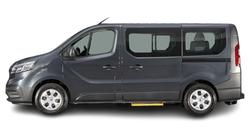
* Images are for illustrative purposes only.
SL30 Blue dCi 150 Advance 9 Seater EAG9
Select your options


No Results Found
Renault's Traffic Passenger is a more sensible kind of really big People Carrier. Jonathan Crouch looks at the updated version.
If you happen to need space for nine people in your next family car and don't want to venture into the used market, you might be expecting to have to pay a lot. But don't sign off a big outlay until you consider this model, the Renault Traffic Passenger. It comes in short or long wheelbase forms with a trusty 2.0-litre Blue dCi diesel engine in three flavours. And, though not very exciting, it may actually be all the MPV you really need. Renault has updated this model for the 2027 model year. And we put it to the test on the smooth highways of Switzerland.
For this update, Renault says it has tuned the electric power steering for 'a more comfortable drive and more precise handling'. And it'll require less effort from you when parking. The brand has also upgraded the braking system, now featuring twin-piston front callipers and larger discs (up from 296 × 28 mm to a more substantial 320 × 30 mm); which reduces pedal effort and delivers more progressive braking, giving drivers finer control over braking force and greater control of the vehicle whatever the driving conditions. There are no engineering changes though, so as before, all Traffic Passenger models for the UK use the same four cylinder 2.0-litre Blue dCi diesel engine with 6-speed manual transmission, but it comes with a choice of three outputs - 110hp, the 150hp version we tried or 170hp. Either way, it's quite a task for such a little engine to pull along a vehicle as big and heavy as this, particularly when fully-loaded, so we would strongly recommend that you find the extra to stretch at least as far as the 150hp version we tested. With this, the 0-62mph time falls from 16.5s to 13.6s and the top speed rises from 100mph to 110mph. Of more significance is the greater pulling power you get from the 150hp engine through the gears - 350Nm of torque, compared to 300Nm in the 110hp variant. That was useful on the steeper Alpine passes we encountered on our trip. Engine refinement was acceptable on the long smooth Swiss autoroutes, though there's plenty of wind noise from the state windscreen and the big side mirrors. But the firm ride felt very van-like; not a problem on the billiard table-like Swiss tarmac, but you'd certainly feel the potholes and speed humps of Blighty. All-round visibility is great around the glassy cabin. The dCi 110 can tow 2,000kg; with the dCi 150 and dCi 170 models, towing capacity rises to 2,500kg, the 170hp variant aided by 380Nm of torque.
The Traffic Passenger looks pretty van-like and frumpy in both of its available body lengths, but honestly, does anyone wanting a vehicle of this kind really care what their big MPV looks like? What's needed is interior space - lots of it. Which we very much required in on our Swiss trip with six people and a lot of luggage to accommodate. You'll need a big garage for this MPV. The body length of the SWB model is 5,080mm; or 5,480mm with the LWB version. Nine seats are available, arranged in three rows of three, with great head room wherever you sit. It's a pity the second row seats can't slide. Renault says that's a compromise caused by the requirement to provide a big enough gap for decent access to the third row. Adult-like space in that third row is fine, but we'd hoped it might be improved by our choice of the longer wheelbase variant. All the lengthier model does though, is give you more boot space out back, though to be fair, that was very welcome on our trip. Renault provides slide-back window panels in the sliding side doors. But there is disappointingly little ventilation for third row folk. Going back to the vast luggage area, you will have to allow plenty of room behind the vehicle to raise the heavy tailgate; unfortunately, the back window can't be opened separately. The cargo floor isn't carpeted (so things slide about on it), but the rear parcel shelf can be placed in different positions to divide up the area. The maximum boot volume of the short wheelbase version is up to 2,625-litres; it's up to 3,570-litres with the long wheelbase model. The significant cabin change with this updated model lies with the installation of a faster, more modern multimedia system. The touchscreen is now two inches larger (10-inches) so the information on it is easier to read, and its response times are twice as fast. The OpenR Link multimedia system is now available in two configurations, and both support wireless smartphone mirroring via Apple CarPlay and Android Auto. The first comes without built-in navigation and the second includes navigation and access to apps. The latter now uses HERE mapping instead of TomTom. Two new USB-C ports make life onboard more convenient. And in the second or third row of seats, Renault provides four USB-C ports per row, providing up to 80W of charging power (enough to power a laptop). LED lighting now comes as standard in the cabin and load area.
Prices for the Traffic Passenger start at around £45,000, which sounds like a lot but isn't in this segment. And you really are getting an awful lot of metal for the money here. There are two trim levels - base 'Advance' or (for £1,800 more) the plusher 'Extra' version we tried. With either trim level, it's £1,650 more to upgrade from the short wheelbase to the long wheelbase model. If you want to upgrade from the base 110hp dCi engine to the 150hp unit, you'll need from around £47,000 - or a starting price of around £51,000 for the EDC auto version we tried. The top dCi 170 variant only comes in EDC auto form - at prices starting from around £53,000. All Traffic Passenger models for the UK come with nine seats. And refreshingly, Renault won't charge you any more regardless of which of the five exterior colour choices you select. The value proposition here is highlighted by the fact that a diesel version of this model's most obvious rival, Ford's Tourneo Custom, will cost you about £10,000 more. 'Advance' spec gets you LED headlights, tinted glass, cruise control with a speed limiter, rear parking sensors, a reversing camera and a volumetric and perimeter Thatcham-approved alarm. Inside, there's manual air conditioning with a pollen filter, and an 8-inch central touchscreen 'easy link' display with a DAB radio, Bluetooth and USB ports. Plusher 'Extra'-spec adds 17-inch alloy wheels, power folding mirrors, front fog lights, 'cyclade' wheel trims, a faux leather steering wheel and smarter 'Java' upholstery. Renault has taken this opportunity to upgrade the safety features available on this model by adding a driver monitoring camera, but there's still little of the ADAS tech you'll find in the brand's passenger cars. Safety features fitted as standard across the Traffic Passenger range include an active emergency braking system and lane departure warning, plus front lateral and curtain airbags. And the usual electronic as assistance for braking, traction and stability control.
The 2.0-litre four cylinder dCi diesel engine in use here is a pretty old unit but it still manages to deliver quite an impressive set of running costs returns. Which for the 110hp version are rated at 41.5mpg on the combined cycle and 179g/km of CO2 for the base 'Advance' model with its 16-inch steel wheels. With its larger 17-inch wheels, the plusher 'Extra' 110hp version is rated at 41.5mpg and 179g/km. The running cost returns with the 150hp version of this same engine are 40.9mpg and 180g/km in manual form (or 40.9mpg and 182g/km as an EDC auto). It's 40.4mpg and 183g/km with the 170hp EDC model. There's a slight downward variance to all these figures if you choose the heavier long wheelbase body shape. This is still the third generation Trafic design; as yet, there's no three-row passenger-carrying version of the all-electric fourth generation Trafic design, the Trafic E-Tech electric. The Traffic Passenger is classified as a Renault commercial vehicle. Which means that as usual with a Renault van , a 3 year/100,000 mile warranty is provided, with no mileage limit for the first two years and roadside assistance for the entire duration. You also get a 3 year paintwork guarantee and a 12 year anti-corrosion warranty.
Even if you dismiss the Traffic Passenger as a somewhat dull means of conveyance, it's hard to ignore the exceptional value proposition it offers. As we discovered on our Swiss trip, it's as big as you could ever need it to be; and the diesel engine is smooth, torquey and economic. Yes, rivals offer more modern designs. But they cost a lot more too. Are they worth the extra over this Renault? On the evidence of this test, we'd have to say no.
1.
Choose from 1000's of brand new cars.
2.
Delivered to your door, direct from our network of dealers.
3.
Delivered to your door, direct from our network of dealers.


